Mamiya 645 vs Hasselblad H
Let’s compare the two popular medium format film cameras, Mamiya 645 vs Hasselblad H system. I share the benefits and drawbacks of each camera as a long term user plus photos and related YouTube videos.

Regular readers will know that I normally use Leica cameras but sometimes you need “more” and for that I turn to larger formats.
Covered in this article
In addition to sharing plenty of images, I include all the information I know around the topic of Mamiya 645 vs Hasselblad H series cameras. The main points covered include –
- Overview of Hasselblad H camera models
- Details on the different Mamiya 645 cameras
- My experience with these 645 cameras
- Common features – Hasselblad H vs Mamiya
- Benefits of a Hasselblad H camera
- Advantages of a Mamiya 645 Super
- Best 645 film camera for travel
- Best 645 film camera for portraits
- 645 portraits with Hasselblad, Mamiya, Fuji, Contax
- Digital portraits with Hasselblad H
- Hasselblad H vs Hasselblad 500 series
- Mamiya 645 vs Hasselblad 500
- Cheapest 645 film camera
- PhaseOne Mamiya
- Hasselblad vs PhaseOne
- More medium format film cameras
Mamiya 645 vs Hasselblad H
If you know of Hasselblad H and Mamiya 645 cameras you’ll be aware that there are multiple versions of each camera. Let’s quickly cover the different Mamiya 645 and Hasselblad H camera models and then I’ll explain what I use.

Hasselblad H series cameras
- Hasselblad H1 – Film only
- Hasselblad H2 – Film & digital
- Hasselblad H3D-31 / H3D-39 – Film & digital
- Hasselblad H3DII – Digital only
- Hasselblad H4 – Film & digital
- Hasselblad H4D – Digital only
- Hasselblad H5X / H6X – Film & digital
- Hasselblad H5D / H6D – Film & digital
*Fellow film lovers need to be careful with the Hasselblad H system. Not all Hasselblad H bodies accept film backs so check before buying. Info is not verified
If you appreciate model photography check out fellow YouTuber and friend Peter Coulson. Peter’s favourite cameras are these Hasselblad H bodies for his studio shoots.

Mamiya 645 cameras
When it comes to Mamiya 645 cameras I have no experience using the later Mamiya AFD cameras. From the information I can find, I would view the Mamiya 645 AF as similar to the Hasselblad H1 with both cameras offering autofocus lenses. The Mamiya 645 AFD cameras are closer to the Hasselblad H2 and H3D, offering both film and digital back options.
Here is a summary of the different Mamiya 645 cameras –
- Mamiya M645 / 645 1000S – Film only
- Mamiya M645 Super – Film only
- Mamiya 645 Pro / TL / 645E – Film only
- Mamiya 645 AF – Film only
- Mamiya 645 AFD / AFDII – Film & digital
- Mamiya 645 AFDIII / PhaseOne 645 AF* – Film & digital
- Mamiya / PhaseOne 645 DF/ DF+* – Digital only
- PhaseOne 645 XF* – Digital only
*Mamiya was bought out by PhaseOne so some cameras can be branded as either PhaseOne or Mamiya like the 645 DF. After that the Mamiya brand ended and cameras were marked as PhaseOne only.

645 cameras I have experience with
Of the all the cameras listed above I’ve owned or own 5 of them. 3 Hasselblad H bodies (H3D-31, H2 and H3D-39) and 2 Mamiya 645 cameras (Mamiya 1000S and Mamiya 645 Super).
Why I love 645 film cameras
The 6×4.5 film format for me is the sweet spot between 35mm film (such as my Leica M-A rangefinder camera) and larger film formats like a 6×6 Hasselblad 501c or 6×7 Mamiya RZ67 Pro II.

How many 645 photos on 120 film?
Depending on which 645 format film camera used, you get either 15 or 16 frames per roll of 120 film. This makes 645 film cameras more economical than larger format cameras. (My Mamiya RZ67 only gives 10 frames per roll by comparison).
I’m not sure if it’s true for all Mamiya 645 cameras but my Mamiya M645 Super gives 15 frames per roll vs 16 frames with the Hasselblad cameras.
Common features of both system
Hasselblad H and Mamiya 645 camera systems have many common features. If we exclude the early Mamiya 645 1000S all models to my knowledge are fully modular meaning –
- Interchangeable lenses
- Wide range of lenses available
- Multiple viewfinder options
- Removable film backs

Benefits of the Hasselblad H system
If we compare Hasselblad H cameras to my Mamiya M645 Super the Hasselblad offers you a list of benefits –
- High quality Hasselblad HC lenses
- Lenses are autofocus + manual option
- HC lenses are leaf shutter lenses
- Highly automated camera
- Endless features for professionals
- Built-in lightmeter
- Auto film advance
- Auto film rewind
- Focus confirmation dot
- Big bright viewfinder
- 1/700 max flash sync speed
- Optional Hasselblad digital back
- Rechargeable lithium battery
- Pop-up fill flash
- Access to Hasselblad V lenses

Drawbacks of Hasselblad H cameras
As you can see from the long list of benefits, these Hasselblad H cameras are fantastic. If I had to list the drawbacks I would say –
- Hasselblad HC lenses are expensive
- Less easy to adapt lenses to HC bodies
- Hasselblad bodies are still expensive
- H cameras are not the lightest
- Full Hasselblad H camera setup is bulky

Why I use a Mamiya 645 Super
You might wonder why I still own the Mamiya M645 Super when I own the seemingly far superior Hasselblad H system? Great question. Let’s now look as reasons you may enjoy a Mamiya 645 camera.
Reasons to get a Mamiya 645
This might depend on personal preferences but the reasons I kept the Mamiya 645 Super are
- Camera is lighter than Hasselblad
- Less battery dependent
- Easier to adapt lenses too
- Mamiya 645 are cheaper to buy
- Mamiya Sekor lenses cost less
- Compact 645 camera setup*
*To make the camera as compact as possible I use the fold down waist level viewfinder and small Mamiya Sekor 80mm f2.8 kit lens.

Best 645 camera for travel?
From the cameras mentioned in this article the Mamiya M645 Super is more ideal for travel based on its size and weight.
If you want something smaller you might want to check out my other 645 camera reviews. Two of the smallest medium format camera options are the –
- Fuji GA645 (Autofocus)
- Fuji GS645 (Manual focus)

Mamiya 645 travel photos

*I still need to develop and scan my Mamiya 645 photos from New York. I’ll add them soon.
Fun fact!
Did you know that there is an A16 Hasselblad 645 film back option for Hasselblad V series cameras (like the Hasselblad 500cm and Hasselblad 501c). With the older more compact Carl Zeiss Planar 80mm f2.8 C lens on a 500 series camera, with a waist level viewfinder attached the size is similar to a Mamiya 645 Super. See my article on Hasselblad 645 photos where I cover both systems.

What camera bag to I use?
To demonstrate quite how compact the Mamiya 645 Super camera is, I carry mine in my Wotancraft 3.5L bags that I got for my Leica M cameras. I carry the M645 in one side of the bag (nose up) and a small Leica in the other side.
I do this with both the Wotancraft 3.5L Pilot and their open top 3.5L EDC Canteener bags. (Note – I also carry my Hasselblad 501c in this way too).


Wotancraft 7L Pilot bag for Hasselblad H3D-39
In comparison, for my Hasselblad H3D-39 camera + Hasselblad HC 100mm f2.2 lens combo I use a 7L Wotancraft Pilot bag with the camera lying length ways and the lens hood attached.

Best 645 film camera for portraits
When it comes to portraits with 645 film cameras what is the best option? As a model photographer I worked my way through many cameras in search of the best. My top 3 film cameras for 645 portraits would be –
- Hasselblad H (Any*) H2 / H3D-31
- Contax 645
- Mamiya M645
What is the best lens for portraits (645 cameras)
I believe these are the 3 fastest aperture lenses made for 645 format film cameras. The fastest is the Mamiya 80mm f1.9 but it’s not my favourite. In order I would rank the lenses as favourite first, but they are all very good. (*HC lenses win for me as autofocus means I can nail my shots + still great rendering).
- Hasselblad HC 100mm f2.2 (autofocus)
- Zeiss Planar 80mm f2 (for Contax 645)
- Mamiya Seker 80mm f1.9 (For Mamiya 645)

Model photography ebook
If you’re looking to get into model photography or want to refine your portrait skills check out my Model Photography Handbook or join me for one of my workshops.

Portraits with 645 film cameras
To illustrate what’s possible let’s compare a selection of portraits from different 645 film cameras. For completeness, I will first include portraits from other camera brands and then we can look at images from both the Mamiya M645 Super and Hasselblad bodies.
Contax 645 film portraits
This was one of my first film cameras so I was still teach myself model photography at this stage. Benefits of the Contax 645 for portraits include auto film advance, modern prism viewfinder and the excellent Carl Zeiss Planar 80mm f2 kit lens.
The famous 80mm Zeiss Planar lens is the main reason you’d buy this camera. Very popular for wedding photographers shooting film, especially a few years ago. (That’s was why I bought mine as I used to photograph weddings).


Fuji 645 Portraits
I’ve owned two Fuji GA645 cameras and the Fuji GS645. These cameras are not as rewarding for portraiture as you are limited by the close focus distance. Both cameras have fixed lenses so you are limited to that given focal length.
Image quality is excellent from these Fujinon lenses and did you know that the Hasselblad HC lenses are also made by Fuji. (As a reminder, Hasselblad 500 series lenses were made by Carl Zeiss).

Portraits with Fuji GA645


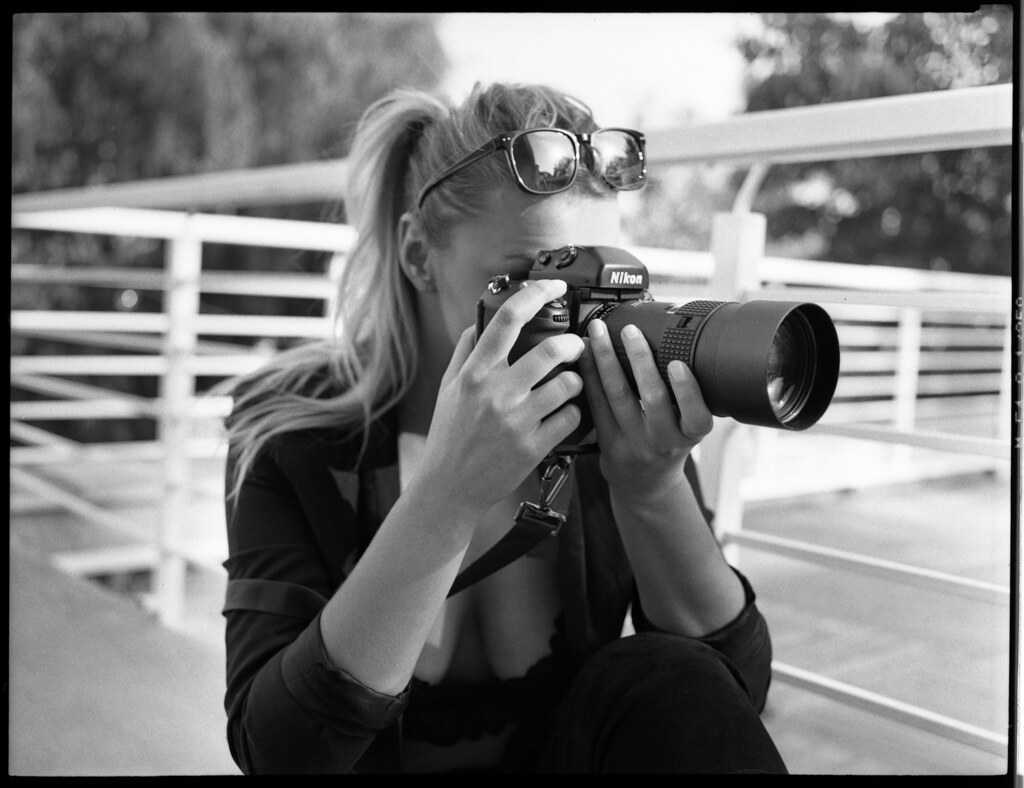

Portraits with Fuji GS645


Mamiya 645 portraits
The main drawback for using a Mamiya 645 Super for portraits is the prism viewfinder is not as rewarding as the waist level viewfinder. Waist level finders are not ideal for vertical / portrait orientation images as you need to hold the camera on its side. It all feels very back to front. If you shoot mostly in the horizontal format ignore this and you’ll be fine.
An additional drawback of the Mamiya 645 Super for studio work is it has a limited maximum flash sync speed of only 1/60. If you plan to use this camera with strobes I recommend buying the dedicated Mamiya Sekor leaf shutter lenses such as the Mamiya Sekor 70mm f2.8 I own.
Although the best portrait lens for the Mamiya 645 system is the older Mamiya Sekor 80mm f1.9, I often take the smaller Mamiya 80mm f2.8 kit lens when overseas. Sharp, lightweight and compact.


Hasselblad 500 645 portraits
To show you what’s possible here are portraits captured with a Hasselblad A16 645 film back on a 500 series camera. If you use a Hasselblad 500/501 with a waist level finder you have the same limitations as mentioned with the Mamiya 645 Super.
The good news is the Hasselblad 45 degree prism eye level viewfinders are excellent. If you don’t mind the added bulk and weight these are ideal for shooting vertical orientation 645 film portraits. My preferred portrait lens for this system is the Zeiss Makro-Planar 120mm f4 but you also have the 100mm, 150mm 180mm and others.


Hasselblad H2 + H3D-31 film portraits
Now let’s look at film images from my preferred setup. It doesn’t matter which H body you get as they all provide most of the same benefits. For me it’s the big bright viewfinder with focus confirmation, excellent image quality with the autofocus lenses and all the mod cons like a digital camera.


*Note – Hasselblad H3D film portraits to follow once I develop/scan my film!
Best Hasselblad HC lenses
Like the older Hasselblad V series cameras, the lenses are leaf shutter lenses so ideal for shooting flash in bright conditions. If you want the best portrait lens for the Hasselblad H system consider the Hasselblad HC 100mm f2.2. For the smallest setup I take the Hasselblad HC 80mm f2.8 kit lens. If you want to get closer get the Hasselblad HC 120mm f4 macro lens (Amazing lens in the studio. I owned this lens too).
Hasselblad 500 vs Hasselblad H
One question you might have is comparing a classic Hasselblad 500 series camera (500cm, 501c etc) vs ‘modern’ Hasselblad H series cameras. What camera system is better, Hasselblad 500 or Hasselblad H?
You clicked this article because you were interested in the 645 film format but as we’ve already covered you can use the older Hasselblad cameras with the A16 645 film back. (You can also get the Hasselblad CFV 100C digital back for the old cameras which gives a 4×3 crop ratio). Let’s quickly list the benefits of each system.
Advantages of Hasselblad 500 series
Reasons you may prefer the classic Hasselblad V cameras include:
- Iconic design
- Camera for life (if serviced)
- Fully mechanical (no electronics)
- 6×6 and 645 film formats
- Amazing Zeiss lenses
- Compact design with WLF
- Additional film backs cost less
- Option to add digital back

Benefits of Hasselblad H series
As I own both systems, here are the primary reasons I pick up the Hasselblad H cameras for some photos –
- Auto-focus Fujinon ‘HC’ lenses
- Option to use Zeiss V series lenses
- Focus confirmation in viewfinder
- Ease of focus vs V series
- Auto film advance/ rewind
- Hotshoe vs coldshoe for flash
- Option to add digital back

Why I own both Hasselblad systems
As you can see from the lists of benefits above, the Hasselblad H cameras tick a different list of boxes to the Hasselblad 500 series cameras. I prefer the classic Hasselblad 500CM and 501c cameras for travel as they pack down smaller (*If I use the waist level finder and a more compact lens).
The camera size is the same with the Hasselblad A16 film back or the standard Hasselblad A12 6×6 film back. Carrying both backs gives me more creative options but I’m sure many photographers just crop 6×6 negatives in post. I prefer to crop in camera.
Travel photos with Hasselblad 501c
I only pack my Hasselblad H2 or H3D-39 for portrait work. For travel I pack an older V series Hasselblad which fits in one side of my Wotancraft 3.5L Pilot back next to a Leica camera.
Here are a few Hasselblad travel photos to inspire you. (I’ve taken the Hasselblad 501c to the US twice when teaching workshops, plus Spain, Hungary, Poland and more).


Mamiya 645 vs Hasselblad 500
As you can see, the older Hasselblad 500 series cameras are closer to using a Mamiya 645 Super. Both cameras are reasonable compact and less automated. Comparing the Mamiya 645 vs Hasselblad 500 –
Benefits of Mamiya 645 vs Hasselblad 501c
- Mamiya 645 cameras are cheaper
- Lenses for Mamiya 645 cost less
- Mamiya 645 camera is lighter
- Size is slightly smaller
- If you want only 645 format
Benefits of Hasselblad 501c vs Mamiya 645
- Hasselblad 500 cameras last forever (if serviced)
- Amazing Zeiss lenses
- Bigger 6×6 negatives (+ 645 option)
- Iconic camera recognised worldwide
- More solid (metal vs plastics)
- Better prism viewfinder
- Flash sync speeds to 1/500

What’s your favourite 645 camera?
Can you see a difference between the various 645 film portraits? Does one camera stand out to you? For me the Hasselblad H cameras took my best portraits and I love that one camera can capture both film and digital images.

Cheapest 645 film camera?
Of the 645 film cameras mentioned in this article, to my knowledge the old Mamiya 645 1000S is the cheapest. Following that other manual Mamiya 645 cameras. Contax 645 became cult cameras so cost mega bucks. Fuji 645 cameras prices jumped a lot once film became cool again. Models like the GA645 are popular for those looking for a 645 point and shoot camera. Hasselblad H cameras have come down a lot in price since release and you can find great deals.

Best bang for the buck?
Older Hasselblad H cameras like the H1 and H2 likely offer the best bang for the buck. I like to use a pair of Hasselblad H bodies with a film back on the Hasselblad H2 and digital back on the Hasselblad H3D-39.
Warning – Most Hasselblad H cameras look near identical but not all viewfinders and backs fit all Hasselblad H camera bodies. Some don’t ‘talk to each other’ and are not compatible.

Digital Hasselblad and Mamiya
We’ve already covered the fact that you can shoot digital images with Hasselblad H cameras. You also have the mirrorless Hasselblad X series cameras like the Hasselblad X2D I reviewed.
Mamiya got bought out by the PhaseOne company so you won’t see new digital Mamiya cameras for sale. The big benefit of both the PhaseOne system and Hasselblad H cameras is you can fit them with CCD sensor digital backs.

Digital portraits with Hasselblad
CMOS vs CCD sensors is not within the scope of this article but let me share a few digital portraits with my Hasselblad H3D-39 and the big CCD sensor to give you a taster.


Note, the Hasselblad H3D-39 sensor is larger than all the mainstream medium format digital cameras like the Fuji GFX series, Pentax 645 cameras and Hasselblad X system. This helps to capture a greater shallow depth of field for portraits.
PhaseOne Mamiya vs Hasselblad
So to conclude, it may sound like a clear victory to the Hasselblad H system? This isn’t quite true as the information I shared isn’t like for like. I compared the far more advanced Hasselblad H2 and H3D-39 cameras against my older Mamiya 645 Super. I use these cameras as both have different strengths to offer. If I bought a later Mamiya 645 autofocus camera these can be much more similar to the mentioned Hasselblad bodies.
If you’re looking for the ultimate digital medium format camera for portraits, the winner is probably the PhaseOne XF (+ CCD back) which costs even more than the hugely expensive Hasselblad H6D-100C.
PhaseOne portraits
If you’re now intrigued by a PhaseOne and want to see example images, check out @TobiasSpranger on Instagram. Tobi is a fellow model photographer, long time Patreon and now great friend that you may have spotted in my YouTube videos.
After 4 years of sharing exclusive weekly content on Patreon we now have almost 1000 members! Read some of the Patreon Testimonials.
Below photo – Tobi with his PhaseOne XF + adapted Kodak Aero Ektar 4×5 large format portrait lens rig (Like I use on my 4×5 Speed Graphic)

Hasselblad vs PhaseOne + CCD Sensors
See this video where I sit down and interview Tobi and we compare Hasselblad vs PhaseOne and chat about the topic of CCD sensors.

Best 645 film camera for you?
Check out this YouTube video were I discuss 11 different 645 film cameras –
Watch on YouTube! Hasselblad vs Mamiya 645
More medium format film cameras
If you enjoyed this article and want to see more medium format film portraits check out my work with these cameras and join the mailing list to get a copy of my free ebook.
- Hasselblad 501c portraits
- Mamiya RZ67 portraits
- Kiev 88 (Arax-CM)
- Mamiya 6
- Rolleiflex SL66E
- Mamiya 7
- Fuji GF670 portraits


I had the original H1 and although only sold as a film camera by Hasselblad mine came with the Phase 1P25 back as well (the film back had never been used). This gave a 16mb raw image and at the time was processed through Capture 1 which came free!
Hi Martin, thanks for the insight. Ah yes I hear the early third party digital backs could be used on some cameras before brands made their own backs. Great to hear you enjoyed this setup! Cheers
Hi Matt, there are a few factual mistakes regarding which Hasselblad H models supported the film back. You mention that H5X/H6X supported film back, whereas H5D/H6D did not, but this is not correct. You can verify this by looking up H5D and H6D official manuals, and they both reference the film back. The reason for H5X and H6X existence wasn’t film backs, but for opening them up for other digital backs (like Phase One). This reddit post has a good summary on the models https://www.reddit.com/r/hasselblad/comments/u275eb/hasselblad_h_series_differences/
Hi thanks very much for correcting me. I was sure multiple people has said certain cameras don’t accept the film back like the H5D/H6D so it’s nice to hear they will work. Thanks Matt
Pingback: Monthly Recap 🔴 Jan26 – Leica Club