Is Leica Monopan 50 the best film for Leica cameras?
What is the best film for Leica cameras? Is the new Leica Monopan 50 film the perfect choice for Leica photographers? Coming up I test Adox HR50 vs Leica Monopan 50 and discuss other film options too (following my YouTube video).

What is Leica Monopan 50 film?
If you Google “What is Leica Monopan 50”, you’ll get an answer something like – “Monopan 50 is a super-panchromatic, ultra-fine grain, ISO 50 black and white 35mm film. Designed for high resolution and excellent tonal reproduction, this film is particularly suited for Leica’s high-performance lenses (and infrared photography)”.
We’ll talk more about what Leica Monopan 50 film actually is as we get into the article but that is how the film is marketed.


First time here? Get your Perks!
Leica branded film
For those of you that love everything Leica, you might enjoy the Leica branded aspect of the new Leica Monopan 50 film negatives. At the edge of the film strip you have the Leica logo printed like other brands do with their films.
Equally, if you like collecting then Leica Monopan 50 is sold in 4 different box designs. That’s 4 good reasons to try this film before we even get into the sample photos. Jokes aside, the boxes do look good. I especially like the red Leica logo box design.

Who makes Leica Monopan 50 film?
Spolier! Although Monopan 50 has the Leica badge on the box, Leica has no experience in making film so it must be made elsewhere. Leica claim the film is made in Germany and it appears to come from Adox (based on the very similar packaging and the fact that my results looked the same). Adox film is produced near Berlin in Germany by Adox Fotowerke GmbH so it makes sense that Leica chose Adox. (Note – Adox film is actually based on Agfa film stock but we’ll talk about below).

Film developing for Leica Monopan 50
If you open the Leica Monopan 50 cardboard box, on the inside are printed developing times for 5 different developers. As I tend to “do my own thing” when it comes to developing I didn’t read the box and did my usual tried and tested approach.
In the YouTube video, I showed that I develop my first roll of Monopan 50 in my standard 1:3 Kodak Xtol dilution. This has works well for me for most of the other films mentioned later in this article but for Monopan 50 (and Adox HR50) it resulted in high contrast negatives. Not great, especially for portraits.
For my second roll of Leica Monopan 50 film I tried developing with roughly a 1:1 Xtol dilution. This resulted in a much improved tonal range and I enjoyed the results (to the point that I would now shoot this film again).

Adox HR50 vs Leica Monopan 50
To see quite how similar my results were from Leica Monopan 50 vs Adox HR50 see the YouTube video below. Both films were shot with Leica cameras, the same lenses, identical settings and developed in the same chemistry in the same Paterson tank. All negatives were scanned and inverted in the same way.
From my simple test, shooting one roll of each film it appears that both film stocks are near identical.
Is Leica Monopan 50 pre-flashed?
You might hear the term “pre-flashed” online. From my results, it looks like Leica Monopan 50 film has the same pre-flash Speed Boost treatment as Adox HR50. My film negatives look identical when viewed side by side in a control setting.
Rollei Retro 80 vs Monopan 50
Is Monopan 50 and Adox HR-50 the same as Rollei Retro 80S film? No but they are all based on the same Agfa Aviphot 80. The main difference is Adox HR-50 has a their “Speed Boost” treatment applied (pre-flashing the film) which results in better mid-tones and shadow details (smoother tone curve) compared to the higher contrast Retro 80S.
Rollei Retro 80S is said to be the raw Agfa Aviphot 80 aerial film meaning it’s easy to blow the highlights due to the higher contrast. (Pre-flash drops the ISO from 80 to 50 on the HR50 and Monopan 50 whereas RR80 keeps the native ISO 80 rating).

How good is Rollei Retro 80S?
Back in 2015 I shot a few rolls of Rollei Retro 80S for my portraits. I think I bought and shot 2 rolls of 35mm RR80 and that was enough for me. I didn’t like the high contrast results for model photography. Some years later I shot another roll for travel photos and it is better for non-portrait work (for my taste at least).


What is Agfa Aviphot 80?
So if Leica Monopan 50 is almost the same as Adox HR50, and HR50 and Rollei Retro 80 films are both based on Agfa Aviphot 80, what is Agfa Aviphot 80?
Agfa Aviphot Pan 80 is a high-resolution, panchromatic black & white aerial film known for fine grain, sharp details, and extended red/near-infrared sensitivity. The ability to penetrate haze makes this film excellent for reconnaissance photos shot from the air. (If you shoot landscapes with long lenses this could be a great film choice for improved clarity).
Monopan 50 price and availability?
After doing a quick online search (and from comments from YouTube viewers) it appears that Leica Monopan 50 is near impossible to obtain at the time of writing. Some say B&H now have stock but on their website it is showing as out of stock. I can’t comment on this other than I hope Leica produces more soon to meet demand.
I was very fortunate that staff from Leica Nuremberg store recognised my buddy Tobi at an expo event so passed on 3 rolls of Monopan 50 to gift to me. Thanks guys! If you ever get a chance to visit the Leica Nuremberg gallery it’s well worth stopping by. (This is where YouTuber “Graindays” had his photo exhibition in 2024).
While you are waiting for your Monopan 50 order to arrive perhaps try some Adox HR50 to give you a taster. I was able to buy HR50 quite easily in the UK (online).

Portraits with Monopan 50 & Adox HR50
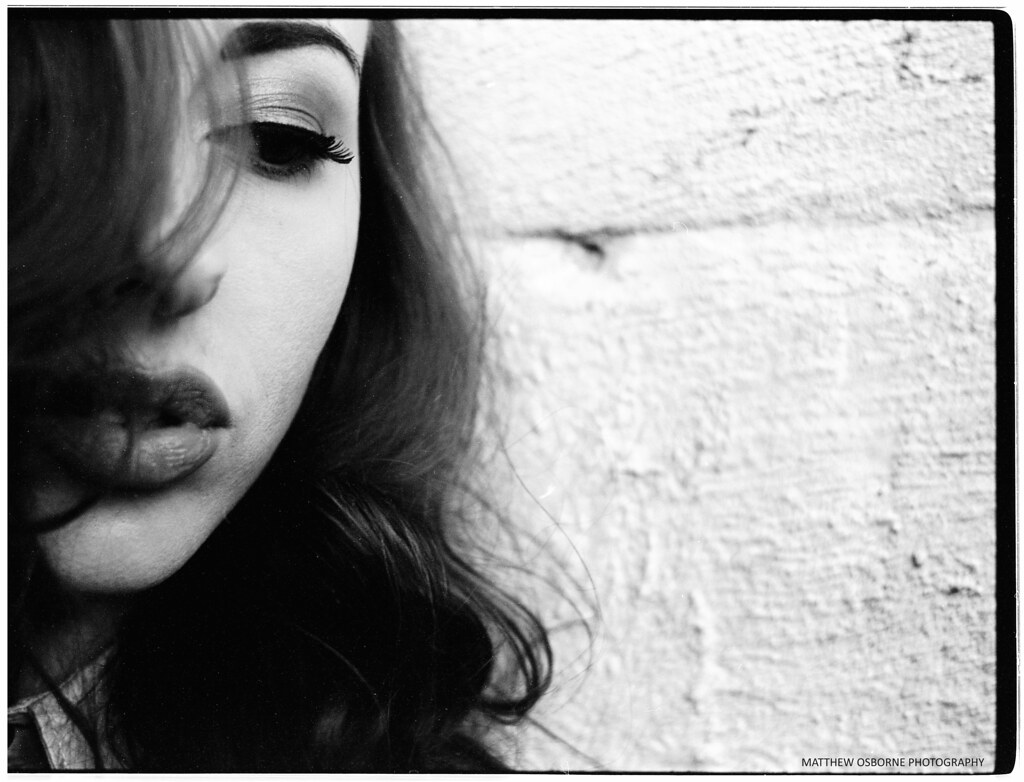
Here are a few portraits taken with these films. I group them as both films gave the same results for me in my testing. Based on my own results I wouldn’t recommend these film stocks for portraits. I really struggled to capture nice looking skin tones even with a profession model because of the very high contrast. (Note – the film scans below have been edited to make them useable). In addition to contrast you have high resolution so the film will show every minor skin imperfection too. (Models will likely hate you if you prefer to not retouch skin like me!)


Super fine grain film stocks
If you love super fine grain film stocks you will likely love Leica Monopan 50 which is said to resolve at 280 line pairs per mm. Other stocks to consider include Adox HR-50, Ilford PanF 50, Adox CMS 20 ii plus the usual Kodak TMax 400 etc. For colour, slide film is king with film stocks like Fuji Velvia 50.
Below are some ~18% crops from the first batch of film negatives I developed to show the fine details captured even with 35mm negatives.


Leica M7 + Adox HR50
Below are some of my Adox HR50 negatives scans shot on my Leica M7 during my YouTube test –


Leica MP + Monopan 50
Likewise, here are some scans from my first roll of Leica Monopan 50 film shot with a Leica MP –


Leica MP in Spain
Sample photos from my second roll of Leica Monopan 50 shot in Valencia, Spain. I used a range of lenses on the Leica MP – See the YouTube video. This film excels for architecture photography and cityscapes.


Darkroom printing Leica Monopan 50
If you have access to a darkroom you will likely love Leica Monopan 50 for darkroom printing. (I converted my only bathroom into a darkroom a while back so now I have to visit the local gym for a shower. Dedication!) The Monopan film resolution is very rewarding for printing. If you saw the video I printed one of my Spain Monopan 50 negatives on Ilford 5×7 Multigrade gloss paper + 8×10 Fomapan paper to see how it performed. Very impressive detail.
What film traits do Leica shooters need?
If we think about us Leica photographers, what are we generally looking for from our black and white film stock? After spending our hard earned cash on nice Leica lenses (and similar from other brands) we likely want a film that offers –
- Extremely high resolution (to show how good Leica glass is)
- Wide tonal range (If developed accordingly)
- Fast speed (ISO) for premium fast Leica prime lenses shot wide open
- Made in Germany
- Reliable results (produced by a well regarded, experienced source)
- Leica logo on the film negatives (if you want that ultimate flex)
- Eye catching box design (Collectible + nice for Instagram)

Best film for Leica cameras?
If you asked me is Leica Monopan 50 the best film for Leica cameras I would say no. An ISO 50 film stock such as Leica Monopan 50 is great on a sunny day with fast glass but what about for all other situations? Leica cameras are famous for street photography but unless you use a flash, ISO 50 isn’t helpful for zone focusing at f8 on a grey sky day. What we need is an ISO 400 speed film for such grey days and indoor photos.
Next up.. Leica Monopan 400?
If Leica Monopan 50 is based on Agfa Aviphot 80 then perhaps we should look to Rollei Retro 400S as to what Leica Monopan 400 could look like. This is purely my prediction*
What is Rollei Retro 400S?
If I predict that the future Leica 400 speed film will be based on Rollei Retro 400S, then what is Retro 400S? Retro 400S is based on the Agfa Aviphot Pan 400S PE1 black-and-white emulsion.
So what is Agfa Aviphot Pan 400S you likely ask? Aviphot Pan 400S is similar to the mentioned Aviphot Pan 80 – A high-speed, panchromatic black and white aerial photography film known for its excellent haze penetration, high contrast, fine grain, and sensitivity to near-infrared light.
When I was shooting Retro 80 film in 2015 I also shot a few rolls of Rollei Retro 400S in both 35mm and 120 formats. RR400s can be nice for portraits thanks to the increased red sensitivity. (Extended red sensitivity reduces skin defects, making it great for portraits and nudes).
The same should be true for Monopan 50 and Adox HR-50 but got better results with Retro 400s vs Retro 80s for portraits. It could be due to the conditions on the day (and the developing methods used). As with Leica Monopan 50 and RR80, Retro 400S is a high contrast film stock so you need to light your subjects accordingly. I’m not saying my sample photos are good but here a two examples –


Monopan 400 – It ticks all the boxes
If I was a betting man, my prediction is that if Leica Monopan 50 sells well their next stock will be Leica Monopan 400 (based on Aviphot Pan 400S). It ticks all the boxes – high resolution, fine grain, made in Germany and now in a more useable ISO 400 speed format. Let’s wait and see!

Best 35mm film for portraits?
As a model photographer (I wrote the eBook), what are my favourite black and white film stocks for portraiture? In theory, Leica Monopan 50 should be good thanks to the increased red sensitivity but it’s not on my favourites list.
Everyone has different preferences when it comes to the film look but personally I enjoy good tonality (across the range), fine grain for 35mm film (if possible) and decent resolution.
If all film stocks were the same price I would likely shoot the premium films – Ilford Delta 400 and Kodak Max 400. When I look back at my images I can often see a notable jump in quality when using premium films (assuming you are looking for finer details captured etc*).
Some of my favourite films
Click the links to see full reviews with sample photos –
- Ilford Delta 100 – 35mm / 120
- Ilford Delta 400
- Ilford FP4 Plus
- Ilford HP5
- Kodak T-Max 100
- Kodak T-Max 400
- Kodak Tri-X 400
- Kodak Double-X 5222
Cheaper films that I’m happy to use
Click the links to see full reviews with sample photos –
Can you spot the difference?
The portraits below are all shot with different black and white film stocks. Can you see a difference in the totality and detail captured? Double click any photo to see the film stock used (+ camera/ lens/ developing details).


Ilford Pan F 50 vs Adox HR 50 vs Leica Monopan 50
I would group Ilford Pan F 50 film similar to the Adox HR50 and Leica Monopan 50 in that these films are less forgiving BUT when you get them right they are very rewarding. I love Ilford Pan F 50 for portraits when I get it right but in harsh light it can be easy to blow the highlights and lose shadow detail.
Maybe I’m lazy but I just tend to learn towards films with greater latitude to minimise the likelihood of me screwing up important negatives of overseas models.
I really should try Ilford Pan F 50 again this year as like Adox HR50 and Monopan 50, the resolution achieved from these 35mm negatives looks more similar to details captured with 120 film negatives. (Tip – To decrease the contrast of Pan F 50 film it’s recommended to meter the film at ISO 25 and then reduce your developing times accordingly. I wonder if that would work for Monopan 50 too?)

Film just looks better printed! Photobooks
After shooting and developing my own black and white film for around 15 years I’m only now really starting to appreciate having tangible prints to hold. I say prints but I’ve been enjoying both making prints in the darkroom and professionally printing photobooks.
I’ve setup a dedicated Photobook page where you can now access books I print. Add your email so not to miss the next print run.


My film choice 2024: Fomapan 100
For years my most used black and white film was Fomapan 100. Pre-Brexit it was crazy cheap if I imported it from an eBay seller in Germany in bulk. Later I found a UK stockist that offer good bulk prices but as time went by Kentmere films became cheaper in the UK. When Fomapan 100 is good it can be excellent but not every roll gives clean looking negatives.


Film choice 2025: Kentmere 400
After some unsatisfactory results from my usual Fomapan 100 film (I think from poor quality control – the dreaded black dots etc) I needed an alternative affordable B&W film stock. In the UK, Kentmere 400 was now one of the cheapest films I could find and it pushes well to ISO 800 (or 1600) so I bought a pile. Overall I’ve been happy with Kentmere 400 but negatives can often look quite flat when shot at box speed.


Fresh film for 2026: Kodak Double-X
I’m no stranger to Kodak Double-X film after buying a 400ft roll to bulk load some years ago. Similar to Kentmere 400 that I used in 2025, this film works for most situations and I happily use it from ISO 100-800.
The advantage of Kodak Double-X 5222 over Kentmere 400 is I get proper black blacks in the shadows and true classic grain structure. Negatives just pop more thanks to the increased contrast vs the muddy grey tones of Kentmere. As someone that likes to shoot timeless looking portraits I’m hoping to create some more great negatives in 2026 for my books.
- Kentmere 400 vs Kodak Double-X – THIS VIDEO


How do I scan my film negatives?
Since last year I continue to scan my 35mm film negatives with the Valoi Easy120 scanner. Designed for both 120 film and 35mm I use this for my 35mm film and my Epson v800 for 120 film (and 4×5 sheet film). The camera I scan with is the Leica SL or Leica SL2-S – both are 24MP.
My process is to scan the negatives with the camera, giving me DNG files. Import the files into Lightroom and apply my MrLeica Film preset A (which inverts the negative). I then export the files as 16-bit TIFs before re-importing into LR. Next I apply the MrLeica Film Preset B to all TIF files to boost contrast etc before exporting as JPEGs.
- See all the MrLeica presets available – HERE
Need more resolution?
When it comes to film resolution you can either use a very fine grain 35mm film like Leica Monopan 50 or pick a larger film format. The smallest 120 film format is 6×64.5 negatives and these are still 2.7x larger than standard 35mm negs. Films like 120 Kodak TMax 400 should easily beat 35mm Leica Monopan 50 purely from the maths and larger surface area.
Check out my recent video about using Leica lenses on medium format film cameras –
Stay updated on the latest Leica news
Add your email to receive the free Leica newsletter and follow on YouTube for future videos. To support my work consider joining Patreon and hope to meet you at one of my Leica workshops!


Hi Matt, you should invest a tenner in some Spur TRX 2000 developer, this was specially developed by Mr. Schain to go along with HR-50. Great developer to control contrast, messed up one day and used the 1:49 dilution on Lomo Fantome shot at 8 ASA and I’m quite happy with the results might do it again with 25 ISO…
Thanks for the info, I’ll have to check out that developer thanks. (I think I have a roll of Fantome 8 in my fridge) Cheers
Thanks Matt for your in depth review – test – of the new Leica 50.
In my 6o years of experience in Photography and 50 years with Leicas (I started very early), eventually I found Agfapan 100 in Rodinal 1:75, shot on my Leicaflex SL and two Elmarits – 35 and 90 – giving the best 35mm film results I have ever seen. Even professional photographers thought at first sight the 8×10 photos were made with a Hasselblad. No kidding.
Thanks for sharing, I read the old Agfa 100 had a high silver content so perhaps that was the secret! Great stuff.
Pingback: Monthly Recap 🔴 Feb26 – Leica Club